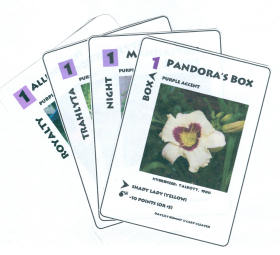
Select a starting dealer. The dealer shuffles the deck
and deals ten cards face-down to each player. The deck is placed face
down on the table as a "draw" pile
and one card is turned face up to start the "discard" pile.
The player to the left of the dealer plays first. (The basic game is
for two players, but it also plays well for three, so these rules are written
for three.)
On your turn, draw the top card from either the draw pile or the
discard pile (your choice) and add it to your hand. Then declare
melds (if you wish) and discard one card face-up to the discard pile. This discard
may be any card in your hand. If the draw pile is exhausted, re-shuffle
the discard pile and make it the new draw pile (do this before the player
who drew the last card discards, so that card will start the new discard
pile).
Each round ends when one player has melded his or her entire hand ("goes
out"), thus presenting a Daylily Festival. The player who goes out
must have a final discard, having melded a total of ten cards.
After a Daylily Festival is presented, record the scores for the round.
(See End-of-Round Scoring.) If no player has a cumulative total
of 100 points or more, play continues. The player who presents a Daylily
Festival is the next dealer.
The Cards
The Daylily Rummy deck consists of 45 unique cards.
There are 15 different daylily flowers (cultivars) which serve as the "suits," with
each flower pictured on three cards: one, two, and three
blooms. The flowers are grouped into five Color Families (Purple, Pink,
Red, Yellow, and Orange) plus Pandora's Box, which exists all by itself.
Each Color Family contains three different flowers except for the Orange
Family, which has only two flowers. (Why? Because when I set out to create
this game, I used only the daylilies in my own garden, and I have fewer
orange flowers than other colors. As it happens, this provides an interesting
twist to the game.) You do not need any prior knowledge
about daylilies in order to play the game successfully, as the pertinent
information is spelled out on the cards. The pictures are mainly for
the player's enjoyment.
Before going further, we will present the five color families so you can
follow the discussion about types of melds. Some melds are made
within the family; others call for cards from different families. All cards
are color-coded, and the color name is also written at the top of each
card so that our color-blind friends will not be at a disadvantage.
- Red Family (3 flowers): Ming Toy, Fly Catcher, Carlotta
- Yellow Family (3 flowers): Stella d'Oro, Shady Lady, Allenhurst Frances
- Pink Family (3 flowers): Flamboyant Vamp, Dublin Elaine, Persian Market
- Purple Family (3 flowers): Manhattan Night, Trahlyta, Allenhurst Royalty
- Orange Family (2 flowers): Infinity, Goebel Porter
- Pandora's Box - exists by itself, and you will see why.
There are three ways to match up your cards to create melds in this game:
Pairs, Trios (which can be runs or sets), and purple Quads. You may declare
melds during your turn by placing them face up in front of you. Once declared,
these cards may not be picked up again and no additional cards may be substituted
in or added to the meld. Opponents may not make any use of these cards.
Trio melds are made within the family, the color family that is. You may
make a Trio meld of reds or pinks or yellows or purples or oranges. Trios
are the most used meld - accounting for up to six of your ten cards -
and come in two flavors: Runs (also called a "sequence"
in some games) and Sets (also called a "book" in some games).
Melds are either Scoring or Safe.
Runs: 1, 2, 3 blooms of mixed flowers in the same color family
is a Safe run, while the harder to achieve 1, 2, 3 blooms of
the same flower is a Scoring run.
Sets: a Trio meld using the same
number of blooms on all three flowers in the family (e.g. the three purple 1 blooms,
the three pink 2 blooms) is a set meld;
set melds are always scoring. Orange flowers do not make set-type
melds. (See Pair
Melds.)
Examples of Trio runs:
1 Carlotta, 2 Ming Toy, 3 Flycatcher (all in the
red family);
also:
1 Carlotta, 2 Ming
Toy, 3 Ming Toy (it is ok to repeat a flower in the same color
family).
This is not a Trio run meld : 1 Carlotta, 2 Ming
Toy, 2 Flycatcher (not a 1, 2, 3 run).
Example Trio set:
1 Carlotta, 1 Ming
Toy, 1 Flycatcher (all in the red family).
This is not a Trio set meld : 1 Carlotta, 1 Ming
Toy, 1 Trahlyta (Trahlyta is not in the red family).
Note: Simply collecting same-color cards does not constitute a
Trio meld; nor does collecting three of the same number of blooms on
cards from different color families.
Flowers that share special attributes may be melded in Pairs.
There are five special attributes: early bloomers, double-blooms, spider
forms, purple accents…and the color orange.
- Early Bloomers: Ming Toy (red) and Stella d'Oro (yellow)
- Spiders: Fly Catcher (red) and Flamboyant Vamp (pink)
- Double-Blooms: Dublin Elaine (pink) and Infinity (orange)
- The Color Orange: Infinity (yes, it has two attributes) and Goebel Porter
- Purple Accents: Shady Lady (yellow) and Pandora's Box
Attributes are designated with symbols in
the upper left corner of the cards. Each special attribute is shared by
just two flower varieties in the deck, and a Pair must contain one of
each. Pairs are almost always made with flowers of a different
color. To continue with the family analogy, if trios are a happy family,
with pairs, you are dating...you don't date your sister, right? Except
for the oranges, which are kind of strange that way.
| Here are the symbols: |
early bloomer:
Ming Toy (red) | |
 |
early bloomer:
Stella d'Oro (yellow) |
spider form:
Fly Catcher (red) | |
 |
spider form:
Flamboyant Vamp (pink) |
double bloom:
Dublin Elaine (pink) | |
 |
double bloom:
Infinity (orange) |
orange:
Infinity | |
 |
orange:
Goebel Porter |
purple accent:
Shady Lady (yellow) | |
|
purple accent:
Pandora's Box |
Quad-melds are only possible in the purple color family. Any purple accent
card (any Shady Lady or Pandora's Box) may be added to a purple Trio to
make it a Quad. A purple accent may not be used within a
purple Trio; it may only be used as the fourth card in a purple
Quad. A Quad must be melded all at once; a purple accent may not be added
later to an already-declared purple Trio ("declared" means placing
it face up in front of you during your turn).
Why all this fuss about pairs and quads? Because you won't
be able to meld your entire ten-card hand in trios!
In mythology, Pandora's Box contains all the evil of the world – and Hope.
So this flower can do a player much harm – or much good.
The good: Any Pandora's Box card in a declared meld earns three bonus points
per PB card. Pandora's Box may be melded as a single flower run of 1,
2, 3 (scoring 12 points – three for the Scoring Trio plus three bonus
points for each card!); or as a Pair with the other purple accent, Shady
Lady; or as the accent card in a Purple Quad.
The bad: Any Pandora's Box card caught in your hand (not part
of a meld) when it comes time to score the round counts minus 10 points against
you .
At the Daylily Festival, each meld is either "Scoring" or "Safe." Each
of your Scoring melds earns you points, regardless of whether or not you
host the Daylily Festival. Safe melds do not score points but they are
still valuable in two ways: they can contribute to your Daylily Festival,
or they can reduce the points the winner gets if you aren't the
one to host the Daylily Festival.
- Safe Pairs have a different number of blooms and matching attributes.
- Scoring Pairs have the same number of blooms and matching
attributes.
Note: Starting with any card to make a Pair, there is only
one other card in the deck with which to make a Scoring Pair meld:
the other flower with the same attribute and the same number of blooms.
If the attribute matches but the number does not, the Pair is Safe.
- Safe Trio: 1, 2, 3 blooms (a run) within a color family
using mixed flowers.
- Scoring Trio Run: when 1, 2, and 3 blooms
are the same flower.
- Scoring Trio Set: three cards share the same
number of blooms.
- Quads are Trios plus an accent card. If the number of blooms on
the accent card matches a set-type Trio, the Quad scores 4 points; if not – or
if the Trio is a run – the fourth (accent) card is "Safe" (while
the Trio can still score its 3 points).
Only declared melds (cards you placed face up in front
of you during your turn) earn points. One point is awarded per card in
Scoring melds. Pandora's Box also earns 3 bonus points
per card when used in any declared
meld, Safe or Scoring. If a meld meeting the criteria
for Scoring is caught in your hand at the end of the round, this meld becomes "Safe" – these
cards do not score for you, but they will not be added to the winner's
score.
To go out, you must be the first player to discard your last card, having
melded the rest of the hand. Do this and you immediately become winner
of the round and presenter of the Daylily Festival.
First, each losing player scores his or her hand:
- Score points only for the Scoring melds declared during the
round.
- Any melds remaining in hand may be discarded but do not score
points.
- Subtract 10 points for any un-melded Pandora's Box card in
that player's hand.
- Place any remaining cards face-down in front of the winning
player.
The host of the Daylily Festival gets points three different ways:
- 10 point bonus for presenting the Festival.
- All Scoring melds played during the round.
- One point per card placed in front of him or her by the other
player(s).
Ending the Round Without a Daylily Festival
(highly unsportsmanlike)
It is possible that every player at the table may have
melded their cards into three trios and be left holding a single card.
If this occurs, the round ends immediately without a Daylily Festival.
Give each player points for the Scoring melds played during the round,
and the dealer of that round deals again. Players
are strongly discouraged from developing this bad habit; the challenge
of the game is to cleverly meld all ten cards.
Game End
The game ends when any player reaches 100 points or
more. If more than one player reaches 100 points at the end of a round,
the player with the highest total wins. In case of a tie, the last player
to present a Daylily Festival is the winner. For a shorter game, set
a lower goal in points or determine how many rounds will be played and
whoever is ahead at the end of the last round is the winner.
Declaring Melds: Balance the need to declare
Scoring melds against the information this gives your opponent(s). If
you declare a run-type meld using pink flowers, your opponent(s) know
they will never draw those cards to meld and may change their plans
accordingly. Thus, you should not declare Safe melds until the end of
the round. Instead, hold onto them and try to convert them into Scoring
melds.
Playing Pandora's Box: To hold or not to hold? How long one keeps a Pandora's Box in hopes
of melding it is a test of one's nerve. It is a good idea to make a Safe
meld in your hand while waiting for the right cards to make a Scoring meld
using Pandora's Box. If a player can go out at this point – or if you are
concerned an opponent is about to go out – it is a good idea to declare the Safe meld and reap the 3 bonus points for Pandora's Box. This
is sole the exception to the advice above against declaring Safe melds
prior to the end of the round.
Selecting Discards:
Because players will not be able to meld more than six cards as Trios, you
will be on the lookout for potential Pairs. Holding onto cards with special
attributes increases your chances of making Pairs. Discarding
an unmatched card with a special attribute is riskier than discarding
a card without an attribute because your opponent is also looking for Pairs.


